
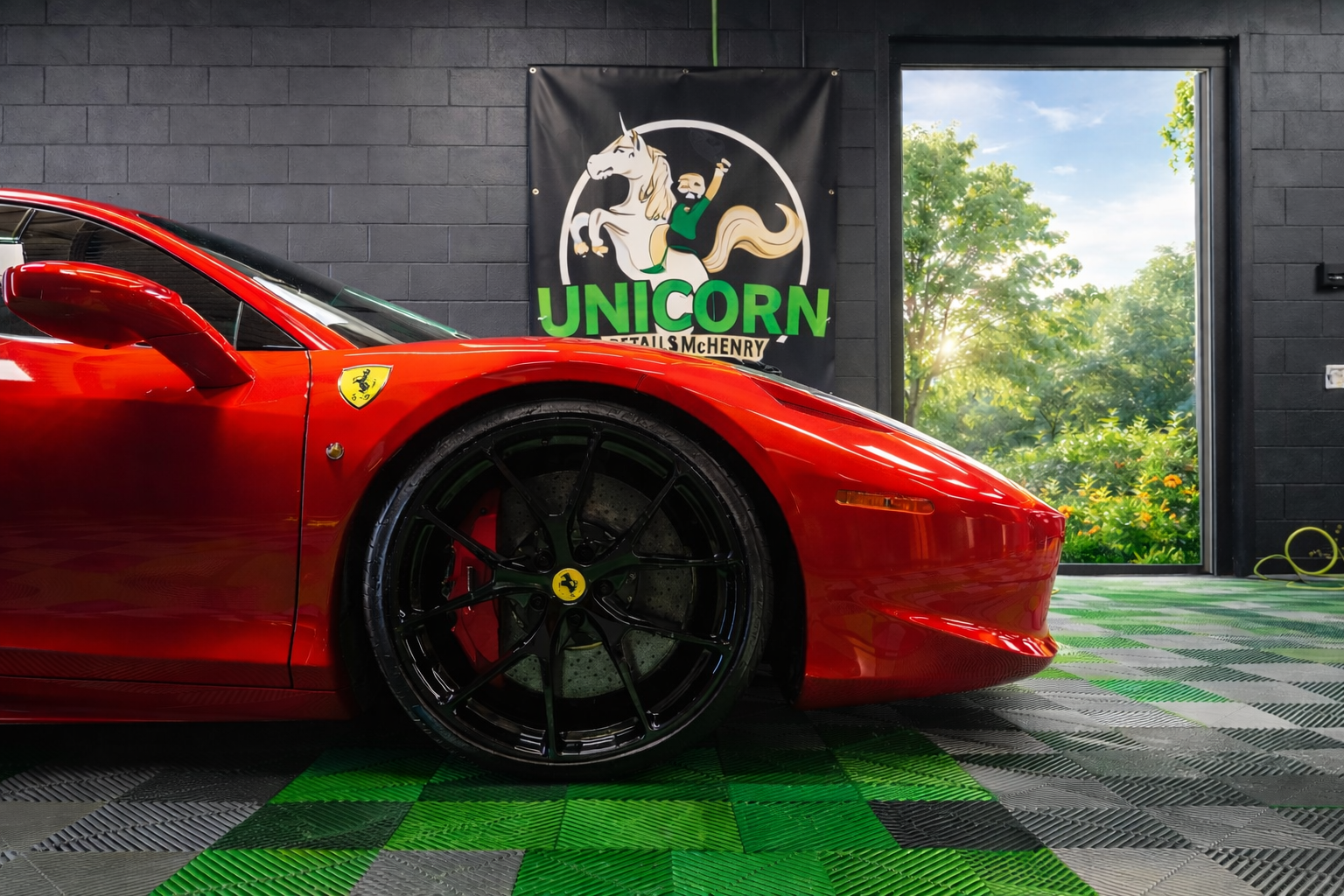
Cars cost more than ever, but a lot of what’s inside them — the plastics, the seats, the paint finish — is built to a tighter budget than it used to be. That’s the honest reason ceramic coating has become such a popular question at our McHenry County shop: people want to know if it’s actually worth it, and how long it really lasts once it’s on the car.
Here’s a straight answer, without the sales pitch.
What Ceramic Coating Actually Does
A professionally applied ceramic coating is a liquid polymer that bonds to your clear coat and cures into a hard, glossy layer. Once it’s cured, it gives you a few real, measurable benefits: water and contaminants bead up and sheet off instead of sitting on the paint, washing gets easier because dirt has a harder time bonding to the surface, and the paint is more resistant to UV fading, oxidation, and everyday chemical staining from things like bird droppings, tree sap, and bug splatter.
It also keeps that deep, wet-look gloss going for years instead of months, which is the part most people notice first.
What Ceramic Coating Does Not Do
This is the part we’re upfront about with every customer, because it gets misrepresented a lot: ceramic coating does not protect your paint from scratches, swirl marks, or rock chips. It’s a chemical-resistant, hydrophobic layer, not a physical barrier against impact. If you’re trying to protect against stone chips on the highway or scratches from an automatic car wash, that’s a job for paint protection film (PPF), not ceramic coating. The two solve different problems, and we’ll tell you which one actually fits what you’re worried about instead of selling you the wrong product.
So How Long Does It Actually Last?
This is where a lot of the confusion comes from, because “ceramic coating” covers a huge range of products. A ceramic spray you apply yourself in the driveway might hold up for a few months. A mid-grade consumer kit might get you six months to a year if you’re careful.
Professionally applied coatings are a different category. As a certified installer for IGL Coatings, Angel Wax, and Optimum Polymer Technologies — along with Nano Pro and Owner’s Pride systems — the products we apply are built for multi-year performance, and most of our customers are looking at somewhere between 2 and 5+ years of protection depending on the specific coating and package.
The bigger factor most people don’t expect: prep matters more than the product. A coating applied over paint that wasn’t properly decontaminated and, when needed, corrected first will fail early no matter how good the coating itself is. That’s the step that’s easy to shortcut, and it’s the one that determines whether you get two years out of a coating or five.
What Shortens the Life of a Coating
A few habits will wear down even a good coating faster than it should:
- Automatic car washes with brushes, which physically abrade the surface over time
- Skipping regular washes and letting contaminants sit on the paint for weeks
- Using dish soap or other harsh, non-pH-neutral cleaners
- Never doing maintenance washes or inspections between details
None of these will destroy a coating overnight, but they add up, and they’re almost always the reason someone’s “5-year coating” is looking tired at year two.
Getting the Most Out of the Investment
The maintenance is genuinely simple: hand wash with a pH-neutral soap, avoid automated brush washes, and don’t ignore the car for months at a time. That’s most of it. We also recommend an annual check-in so we can look at how the coating is holding up and catch anything early rather than after it’s already worn through.
We’ve applied over 600 ceramic coatings since 2015, and the honest answer is that the coating is only half the equation — how it’s prepped and how it’s maintained afterward does just as much work. If you’re trying to figure out which coating package actually makes sense for your vehicle and how you drive it, that’s a conversation worth having before you buy anything.
Reach out and we’ll walk through it with you, no pressure either way.
